This week on Driving Law, Kyla Lee and Paul Doroshenko look at the growing legal problems surrounding e-scooters, e-bikes and other personal electric mobility devices in British Columbia.
Welcome to British Columbia’s only weekly DUI law update newsletter. This newsletter contains the most cutting-edge information, the newest case law, and helpful practice tips for DUI defence in BC.
Authored by Kyla Lee, BC’s Impaired Driving Update is released weekly on Thursdays.
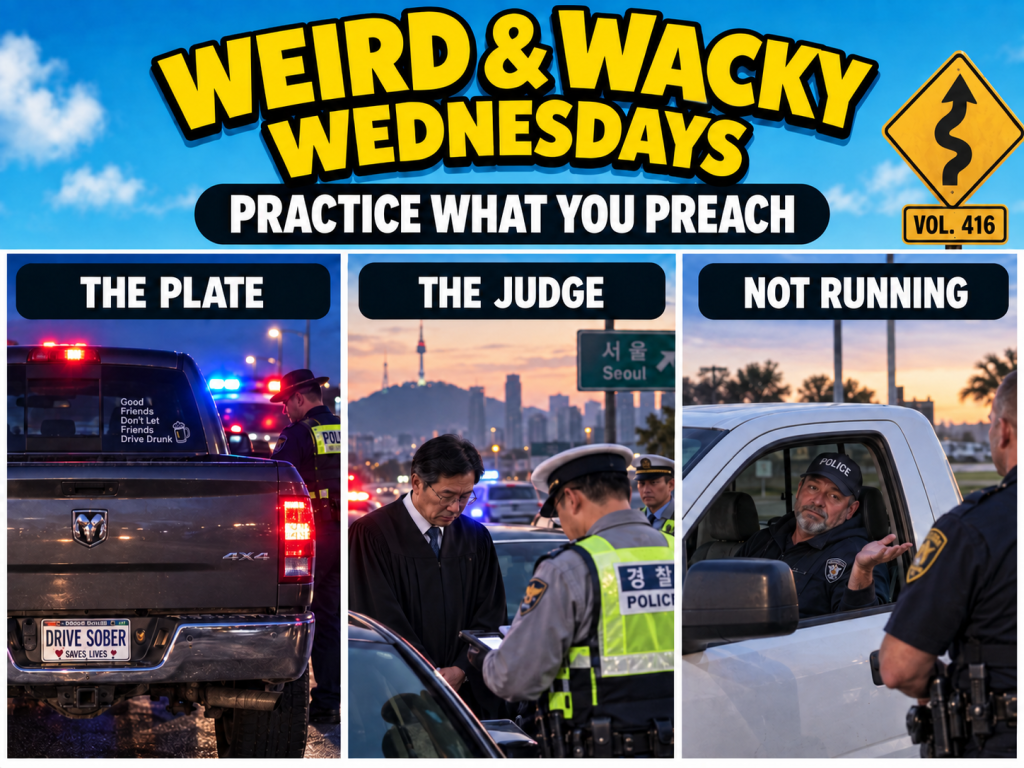
This week on Weird and Wacky Wednesdays: Practice What You Preach
Last week our subjects made plans. Elaborate ones, in a couple of cases, and every plan made the situation worse than doing nothing would have.
This week nobody needed a plan. Each person in this column already knew the rule. One of them was driving around with the rule printed on a licence plate. One of them spends a working life applying rules to other people. One of them is sworn to enforce them. Knowing the rule turns out to be a very different thing from following it, and in one case knowing the rule almost helped.
The plate
On Saturday, August 8, Arizona DPS troopers stopped a pickup truck on Route 66 near Flagstaff. The reason for the stop was a broken taillight, which is about as ordinary as a traffic stop gets.
Troopers said they noticed signs of impairment as soon as they reached the window. The driver admitted to drinking and driving. A blood alcohol test came back at 2.5 times the legal limit.
The vanity plate on the truck carried an anti drunk driving message. DPS released a photograph of it along with a one line summary of the whole affair: “A lesson in practice what you preach.”
The driver has not been named and faces a charge of driving impaired. The allegations have not been proven in court.
The judge
At about six in the morning on September 9, police in Seocho-gu, Seoul, received a report from a member of the public about a vehicle that appeared to be driven by an impaired person. Officers located the vehicle and the driver.
The driver is a sitting judge of the Seoul High Court. Korean reporting does not name the judge, in keeping with local practice, and refers to them only as Judge A. Seoul Seocho Police Station is investigating under the Road Traffic Act. The reported blood alcohol concentration was at the level that brings a licence suspension. Nobody was hurt. No charge has been laid, the investigation is ongoing, and nothing has been proven.
The officer in the parked truck
At around five in the morning on August 16, Key West police found an off duty officer of their own department sitting in the driver’s seat of his parked white Ford pickup.
Officer Dustin Christina, 40, was asked how much he had to drink. He said, “I had a few.” He then said he had not driven the truck to that spot. According to the arrest report he put it this way: “I didn’t do anything. I’m f—ing waiting for someone to get me and then they left and now I’m waiting.”
Officers described a blank stare, bloodshot and watery eyes, a flushed face and the odour of alcohol. They said that when he got out of the truck he stumbled backward into it and pushed himself off with his legs, then tried to close the driver’s door, missed, and stumbled away from the vehicle.
They also said that a couple of hours earlier they had seen him driving the truck around the corner from Greene Street onto Ann Street, and that a woman had to run up onto the curb to avoid being struck.
Asked to perform sobriety tests, he declined. His reason, per the report, was this: “Nah, I’m not doing it. I’m sitting here in a non-running vehicle.” He was arrested.
Those who should know better
A driver who was advertising the rule. A judge who applies rules for a living. An officer who enforces them. All three are presumed innocent, and the judge has not been charged best I can tell.
But none of them was short of information. Whatever ends up being proven, the thing that was missing was never the knowledge. It was the twenty seconds between knowing a thing and doing it, which is what most of this column has been about since the start.
Practice what you preach. Hypocrisy is always fodder for Weird and Wacky Wednesdays.
Most people picture an impaired driving investigation as a stop on the side of the road, a breath sample, and a short ride to the police station. When a collision is serious enough that the driver is sent to the hospital, the investigation looks very different. The rules, your rights, and the evidence that gets collected all change. If you were taken from the scene of a crash to a hospital and later charged with impaired driving, the investigation almost certainly went down one or more paths that are worth understanding before you decide how to respond.
Welcome to “Cases That Should Have Gone to the Supreme Court of Canada, But Didn’t!”
In this episode, Kyla Lee from Acumen Law Corporation examines a constitutional challenge to Alberta’s requirement that prospective lawyers swear an oath of allegiance to the monarch. A prospective lawyer argued that the requirement conflicted with their religious beliefs and violated their Charter-protected freedom of religion. The requirement was ultimately found unconstitutional, raising broader questions about what lawyers’ oaths are intended to represent and whether there should be greater consistency across Canada.
BC is preparing to replace its intersection enforcement cameras with technology capable of doing much more than photographing speeding and red-light violations. In Episode 469 of Driving Law, Kyla Lee and Paul Doroshenko discuss what those expanded capabilities could mean for driver privacy and government surveillance.
Welcome to British Columbia’s only weekly DUI law update newsletter. This newsletter contains the most cutting-edge information, the newest case law, and helpful practice tips for DUI defence in BC.
Authored by Kyla Lee, BC’s Impaired Driving Update is released weekly on Thursdays.
As I traveled around British Columbia this summer, I witnessed a lot of bad driving. There were a number of crashes, and in most cases those crashes were the result of people making really poor decisions. It dawned on me that my weekly column here is very often about people making really bad decisions. Most people who turn up in this column got caught doing something stupid with very little forethought.
This week I was considering the degree of forethought people put into their poor decisions. Our subjects looked at the problem, arrived at a solution, and committed to it. In each case the solution was considerably worse than the problem. All are recent cases. For some it was a summer of bad decisions.
In February 2026, West Vancouver Police announced charges against Derek Silva, a 38-year-old Squamish man, for dangerous operation of a motor vehicle and flight from police. The allegations stem from a late-evening incident on the Sea to Sky Highway the previous October. Police say an officer clocked a vehicle travelling westbound at very high speed and chose not to pursue. Instead, they coordinated with other agencies to intercept the driver further along the route.
The allegations have not been proven in court. Mr. Silva is presumed innocent. But the case is a useful window into how these charges work in British Columbia, what police strategy now looks like, and why anyone facing similar charges needs experienced representation.
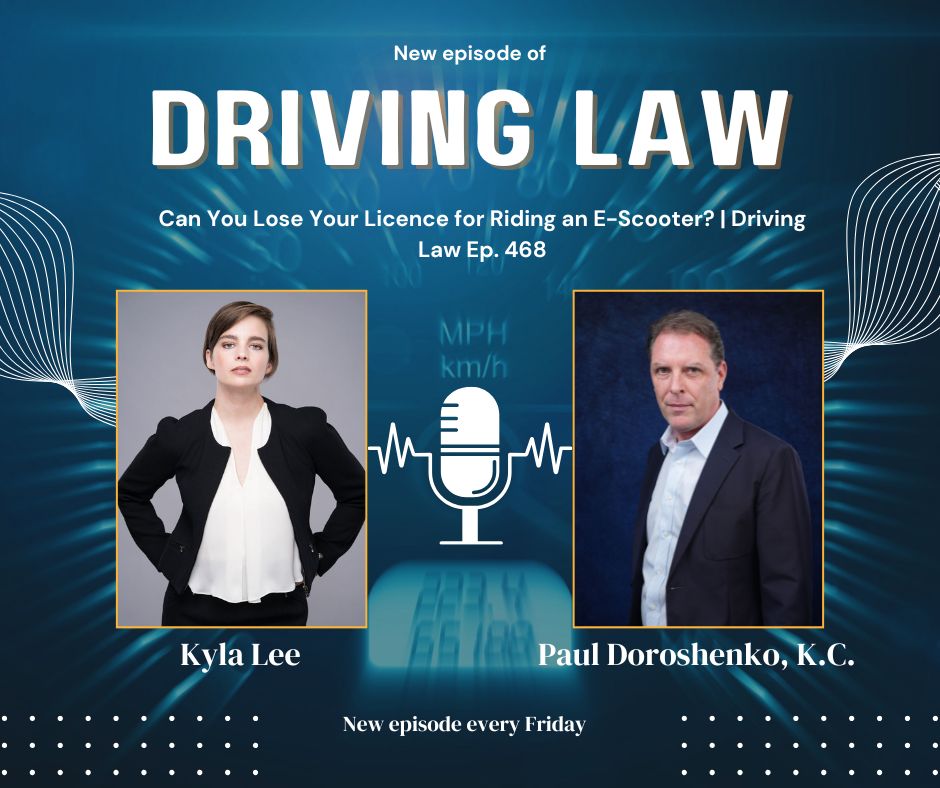
E-scooters are becoming faster and more common, and police are taking notice. In Episode 468 of Driving Law, Kyla Lee and Paul Doroshenko discuss a recent crackdown on e-scooter riders and the potentially serious consequences when a scooter no longer meets BC’s legal requirements.